I moved to New
York City last July. Last week, I received the below solicitation for
membership from the Museum of Modern Art (MoMA). The Outer Envelope Teaser
reads, “Welcome to the Neighborhood!” Inside is an offer of discounted
membership “… available only for our new neighbors.” However, I moved to New
York City last July.
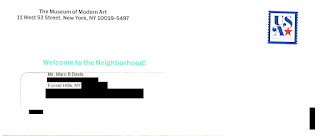 |
Inviting Outer Envelope
"Welcome to the Neighborhood!" |
I can only
speculate why I received a solicitation with this type of messaging after
living here nearly a year. Did MoMA purchase a hot movers list that wasn’t
so…hot? Did the mailer obtain my information several months ago but didn’t use
it until now (e.g. a Fail for Timing)? If either of these is true, that is poor targeting (e.g., a Fail for List). Did MoMA know I moved more than 10 months ago but chose to position
their solicitation as being for new residents? If so, that appears to me to be
a Fail for Creative, because the messaging is not relevant.
 |
| Front of letter |
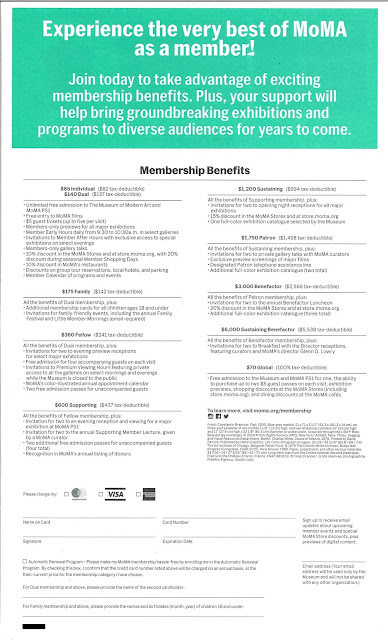 |
| Back of letter includes many membership level options |
Aside from that
point, creative execution is quite good. The package includes many of the
elements known to support optimizing response:
- Outer Envelope.
The outer envelope clearly identifiers the sender. It is stamped, which
suggests a personal correspondence. The teaser “Welcome to the Neighborhood!”
is in an inviting color.
- Letter. In lieu
of a typical Johnson Box, the letter tastefully displays what a new member
might expect to enjoy at the MoMA. Displaying the organization name and return
address on the side (as well as choosing a font that visually matches the MoMA
brand identity) is inviting. The interior highlight colors match the outer
envelope teaser. The copy describes the overall benefits of membership and is
inviting. The letter is personally signed by a relevant individual, and it
closes with a postscript that reinforces the offer.
- Buckslip. The
buckslip insert clearly and simply reinforces basic membership benefits and
includes a call to action.
 |
| Buckslip insert |
- Personalized
Response Form. The Membership Acceptance Statement already has the prospective
member’s name and address. The form includes mention of to whom to make out a
check and includes an option to pay the membership fee using a major credit
card.
- Business Reply Envelope. The reply envelope is postage-paid, meaning the recipient won’t need
to spend effort finding an envelope or a stamp. The FIM Bar and barcode will
ensure smooth and fast response delivery.
 |
Standard Business Reply Envelope
Prepaid postage allows for easy return & fast delivery |
This solicitation
may also deserve a Fail for Offer, because there are too many and they are
confusing. The front of the letter lists four membership options, while the
back of the letter lists nine – with costs ranging from $70 to a whopping
$6,000. If the people being solicited are new to the neighborhood, they are
likely not ready to put down more than a couple hundred dollars on membership
at a museum. They may also not be willing to take the time to understand the
difference between the $70 “Global” membership listed on the back and the $70
“Individual” membership listed on the front. This forces the consumer to make a
decision within a decision – to first make a decision whether to be a member
and then to make a secondary decision regarding the type of member to be.
Forcing the secondary decision risks prospective member frustration, which
leads to delayed or no action on the primary decision.
It would be worthwhile
to communicate only two to four entry-level options for new members, then take
action to upsell them later when they call to join – or upon their first
enjoyable visit to the museum.
In addition to
caring for the Fails, there are a few minor optimizations I would consider with
this type of solicitation:
- Open the letter
with the recipient’s name. Perhaps there wasn’t space with this design; but, if
you are going to take the effort of having a personal-style letter
solicitation, open with “Dear Marc Davis” – or, if the list source data allows,
“Dear Marc.”
- Explain some
elements a bit better. When communicating museum features and benefits,
consider the fact that the intended recipient is new to New York City. For
example, the back of the letter and the buckslip mention free admission to
“MoMA PS1.” A new neighbor might confuse that with something related to a SonyPlayStation.
- Reinforce the
promo code. To get the discount, the new member has to enter a promo code
mentioned in the body of the letter. Someone simply scanning the letter,
however, would be hard pressed to find it. It should be listed in the
Acceptance Statement in #1 under “Four easy ways to join” and it could be
reinforced in the postscript.
- Create a
matching landing page. The current call to action mentions moma.org/join, which
appears to be the standard page for new member enrollment. Unfortunately, that
page has even more options than the letter – creating even more potential for
confusing prospective members – and the page also doesn’t reference the new
member discount. This means the recipient of the letter couldn’t use it to get
the targeted discount. A matching landing page can have an inviting URL (i.e.,
moma.org/newneighbor), visually match the solicitation, and
show only simplified, relevant membership levels at the offered price without
forcing the new member to enter a promo code. In addition, quantifying page
visits can support gauging overall prospective membership interest resulting
from the solicitation.
- Avoid the zip+4
on the outer envelope return address. This bit of technical accuracy doesn’t
help optimize mailing the package and detracts from the light, personal feeling
of the solicitation.
One needs
creative skills to design the right type of communication for the target
audience to mail at the best time. But is it art? Well, maybe – but the actions
of measuring, testing, learning, and optimizing mean it is also math.
Maybe, one day,
MoMA will have an exhibit featuring creative elements of successful direct
mail, perhaps next to a Swatch Jellyfish watch or Macintosh classic desktop computer.
Lessons:
- When choosing
to communicate to prospective customers around life events, make sure your list
source is accurate – and mail on a timely basis.
- When
soliciting new customers to your program, offer few and simple options.
(Edited to correct hyperlinks.)