When someone asks me if I have children, I sometimes joke, "None to my knowledge." In that context, when I receive a postcard asking me, "Looking for a pediatrician or pediatric specialist?" I have to wonder if someone knows something I don't.
Let's set aside for the moment the fact that I do not have any offspring and break down the postcard's content.
 |
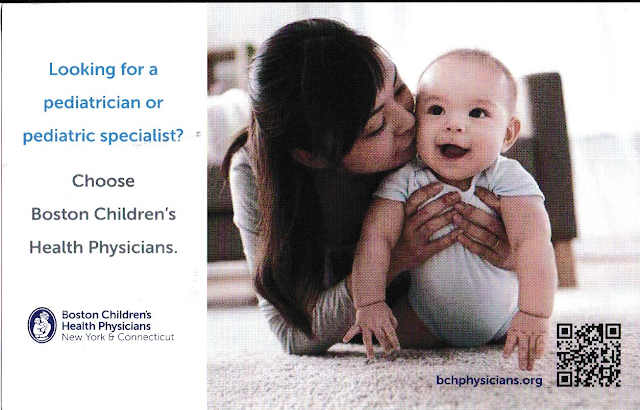
| Mommy is happy with her healthy baby. |
The front of the postcard simply suggests that I choose Bost Children's Health Physicians. It doesn't suggest
why I choose one of their doctors. What makes their physicians desirable? To put it in marketing terms, what is BCHP's
unique selling proposition?
 |
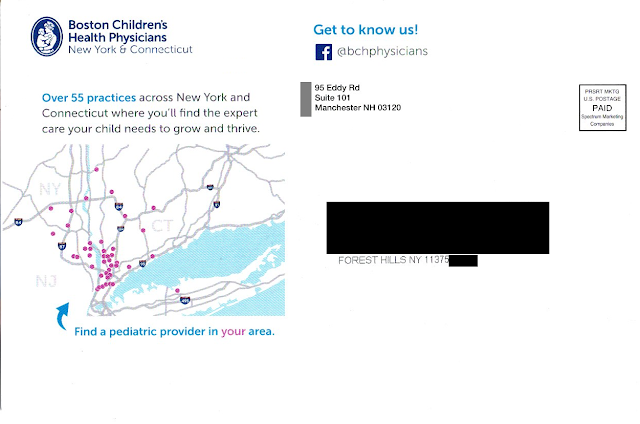
Where is Forest Hills, Queens? Not in the area shown on the postcard. |
The address side of the postcard includes a minor sales
message that supports the
Call to Action – to “find the expert care your
child needs to grow and thrive.” And the postcard displays a map that appears
to show the locations of doctors. There is an arrow pointing to the map,
reading, “
Find a pediatric
provider in your area” with emphasis on “your.” Quick takeaway: most of New
York City doesn’t even appear on the map.
Maybe there is a provider near me, but how would I know?
Rather than communicating how to find the provider – and placing it next to the
Call to Action to do so – there is a bunch of white space below the map. The
response method is on the other side of the postcard…well, sort of.
Buried on the bottom right corner of the picture of mom and
her smiling baby is a URL leading to the
Boston Children’s Health Physicians home page. Somewhere on that home page is information that supports the
postcard’s messaging, but it isn’t easy to find. The QR code doesn’t lead to
the same page as the URL; it leads directly to the
practice locator page.
And the placement of the QR code (within an image on the opposite side) is a
Fail for Creative.
 |
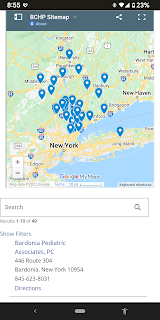
| BCHP locations not quite near Queens |
Let’s get back to finding a provider in my area. I tried the
QR code on my smartphone. It indicated that the nearest practice was in
Bardonia, NY.
As the crow flies, the distance from Forest Hills, Queens, NY to Bardonia is about 27 miles. As
the parent drives in traffic, however, it is two toll bridges and typically an hour drive or longer with a sick or tired child in the back seat. (That
assumes the parent has a car. After all, this is New York City.) This long
distance to a physician confirms that the postcard was poorly targeted geographically – another Fail for Targeting.
Returning to the caption below the map, what is a “pediatric provider?” Why use that kind of industry jargon when the front of the postcard uses “pediatrician” and “pediatric specialist” while the address side of the postcard cites having 55 “practices”? Why throw yet another term out there? I realize I’m not a parent but, if I were, wouldn’t I want to find a “doctor” for my child?
IMHO, this postcard does not
really support Boston Children’s Health Physicians. It is poorly designed,
written, and targeted.
Finally, unless there is a back-end method in place for
tracking response to the individuals being mailed, this isn’t direct marketing
– it’s mailed advertising.
Lessons:
- Vet your data sources to target matching demographics.
- Just being available is not enough. Even a medical practice needs a differentiator.
- The means of following through on a Call to Action should
be located close to the Call to Action, and easy to find.
- Vet your physical targeting to people who can easily get to your physical business or medical practice.
- If your Call to Action includes a web site, don’t just list
a home page. Use a direct URL that aligns with the Call to Action.
- Apply jargon consistently using terms your customers understand.
- Even a postcard for a medical practice should include some
method of tracking results.
Edit 2/11/23: Removed reference to company that sent the mail per request of a person working at that company.